Job Scout: An AI Agent
Your autonomous AI career agent
Section titled “Your autonomous AI career agent”TL;DR — Job seekers are still searching, matching, and applying manually while employers use AI to screen them. We’re building an AI agent that searches LinkedIn for relevant roles, matches them against your CV, tailors your resume and cover letter for each strong fit, and tells you which jobs are actually worth applying to — so you spend your energy on interviews, not busywork.




The Problem
Section titled “The Problem”Job searching is a full-time job — except most people already have one.
Every open role means the same manual grind: scan LinkedIn, read a job description, guess which keywords the applicant tracking system wants, tweak the resume (again), write a new cover letter (again), and hope for the best. Multiply that by 20 or 30 applications, and it’s easy to see why so many strong candidates give up early or apply half-heartedly — not because they’re unqualified, but because they’re exhausted.
Meanwhile, the roles that are the right fit often get missed entirely, buried under a flood of listings that don’t match the applicant’s skills, seniority, or goals.
The Opportunity
Section titled “The Opportunity”Recruitment has already been transformed by AI on the employer’s side — smart filtering, automated screening, ranked shortlists. Job seekers, on the other hand, are still doing this the way we did it in 2005: manually, repetitively, and without any real feedback loop.
That imbalance is the opportunity. If AI can help companies find the right candidate faster, it can just as easily help candidates find — and win — the right job faster. The same technology, pointed the other way.
The Proposal
Section titled “The Proposal”JobScout is an agentic AI job-search assistant that automates searching, scoring, and tailoring resumes/CVs for job postings with human-in-the-loop approval. It orchestrates multiple LLM-powered modules — resume parsing, tailored content generation, cover-letter writing, semantic matching, and persistent storage — in a repeatable scouting cycle.
What it does NOT do: submit applications on your behalf. It stops at producing ready-to-review files; you apply and track status manually. That boundary was a deliberate design choice, not a missing feature.
The Value
Section titled “The Value”- For applicants: less time searching, higher-quality applications, better match rates, less burnout
- For the hiring process broadly: candidates show up better prepared and better aligned to the role, which benefits recruiters too
- For the market: a small step toward leveling the playing field between employers’ AI-powered hiring tools and candidates’ still-manual job search This is the starting point. More to come as the design and build progress — including how matching quality is measured, how we handle personalization without losing authenticity, and where human judgment stays firmly in the loop.
The pipeline
Section titled “The pipeline”One run of the agent does, in order:
- Search — pulls open roles from LinkedIn (via a job-board API).
- Skip what’s already been checked — a local record of every job seen before, so the same posting is never re-scored or re-tailored twice.
- Score — compares each new job against a base resume using a hybrid of semantic similarity and skill overlap, producing a 0–100 match score.
- Filter — keeps only jobs above a configurable threshold, sorted best-first.
- Tailor — rewrites the resume for each surviving job: reordering and re-emphasizing real experience to match the role, never inventing skills, employers, or claims that aren’t in the original.
- Write a cover letter — grounded in the same real facts, specific to that job.
- Package — writes a folder per job (job posting, tailored resume, cover letter as polished DOCX/PDF) and adds one row to a tracking spreadsheet you update by hand (status, follow-ups, notes).
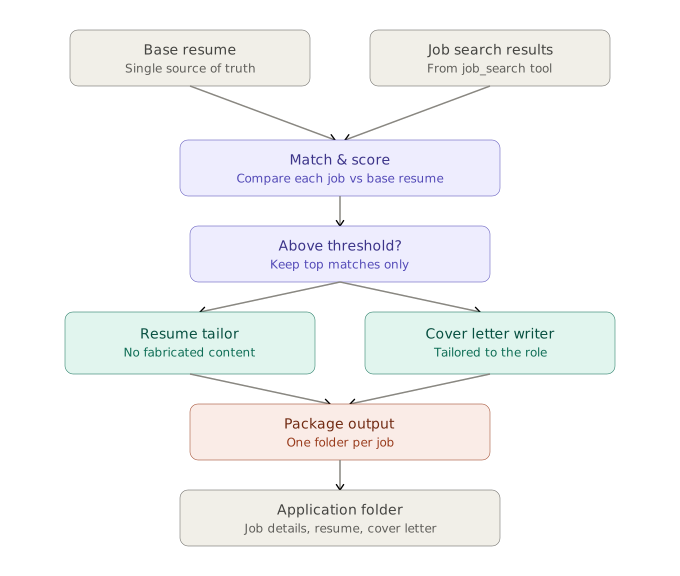
JobScout matching and tailoring pipeline